digital storefront seo and ai visibility
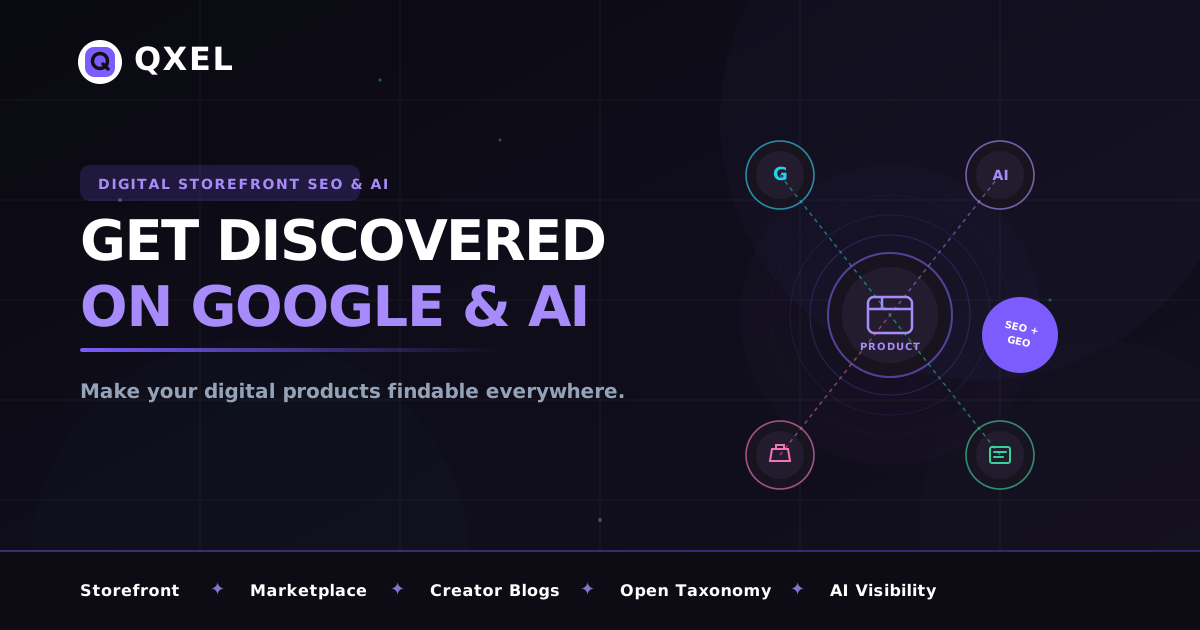
Digital Storefront SEO and AI Visibility: Get Your Products Discovered on Google and AI
Sell digital products that are easier for search engines, marketplaces, and AI systems to discover.
Creating a great digital product is only half the job. The other half is making sure people can actually find it.
Today, digital product discovery happens across more places than Google. People search Google for products, browse marketplaces, read creator blogs, compare solutions, and increasingly ask AI assistants what they should buy, use, learn, or download.
If your digital product exists only behind a social media link, a private checkout page, or an isolated storefront, much of that discovery opportunity can be difficult to capture.
Qxel is designed to give your digital products more places to be discovered through your storefront, individual product pages, the Qxel marketplace, creator content, structured product information, and an open taxonomy built around what you actually sell.
The goal is simple: make your digital work understandable and discoverable wherever people look for it.
SEO Is No Longer Just About Ranking One Webpage
Traditional SEO usually starts with a simple question: "How do I get my website to rank on Google?"
That still matters. But digital product discovery is becoming more distributed.
Someone looking for a product might search Google for "best Notion templates for students," "where can I buy UPSC study notes," "best Canva templates for small businesses," or "where can I find Excel financial models."
The same person might ask an AI assistant essentially the same question.
AI systems can use web content, structured information, product data, and other sources to construct answers and recommendations. As AI-powered product discovery develops, the way products are represented online becomes increasingly important.
That creates a broader objective for creators.
Don't only build a storefront. Build a discoverable digital presence.
Qxel Gives Digital Products Multiple Discovery Surfaces
A Qxel creator isn't limited to a single product page. Your digital business can have several connected surfaces that serve different purposes.
Your storefront gives your products a dedicated home. Instead of sending customers to a payment link with very little context, you can present your products in a proper storefront where visitors can understand what you create and explore your catalogue.
Each product can have its own description, category, product information, and purchasing path. Qxel provides storefront creation without requiring creators to build everything from scratch or write code.
Your storefront is the foundation, but it doesn't have to be the entire discovery strategy.
Qxel Marketplace Discovery
Your products can also exist within the broader Qxel marketplace rather than only on your individual storefront.
That creates another path between a potential buyer and your product.
Instead of relying entirely on the traditional path of creator → social media → product, discovery can also happen through buyer → marketplace → category → product.
This distinction matters when you're trying to build discovery beyond an existing audience.
A creator with a small social following can still benefit from creating products that are clearly categorized and discoverable within a broader digital marketplace.
Creator Blogs Turn Questions Into Discovery Opportunities
A product page answers one important question:
"What is this product?"
A creator blog can answer another:
"Why would I need it?"
That difference is important for both SEO and broader digital discovery.
Imagine that you sell a digital product called "100 Canva Templates for Indian Small Businesses."
Your product page can explain what the templates contain. But your creator blog can also publish genuinely useful content around the problems those templates help solve.
You could write about creating Instagram posts for a small business, planning a month's social media content, finding content ideas for Indian businesses, or creating social media designs for restaurants.
Those articles create additional contextual pages around the product.
The relationship becomes:
Blog → topic → problem → product → purchase
Instead of forcing one product page to rank for every possible search query, you can create useful content around the problems your product solves.
Qxel provides creator blogs as part of its creator ecosystem, allowing creators to build content around their expertise as well as their products.
Open Taxonomy Makes Digital Products More Specific
One of the challenges with digital products is that they don't always fit neatly into traditional marketplace categories.
Consider a Notion study planner, a Python API starter kit, a Kerala PSC preparation bundle, an Instagram carousel template pack, a financial model for Indian startups, a university project report template, a Lightroom preset collection, or a resume template for software developers.
These products are all digital, but "digital products" tells a potential customer very little about what they actually are.
Qxel's Open Taxonomy System allows creators to use existing categories or create categories and product types that better reflect what they sell.
That specificity matters because better product descriptions create better context.
"Digital product" is broad.
"UPSC CSAT quantitative aptitude practice questions PDF" is specific.
"Notion study planner for engineering students" is specific.
"React SaaS dashboard UI kit" is specific.
The more accurately a product can be described, the easier it becomes for discovery systems and potential customers to understand what the product actually is.
SEO Starts With Describing Your Product Clearly
There is a common mistake in digital-product marketing: writing product descriptions for humans while forgetting that search systems also need clear information.
Compare a vague description such as:
"Take your productivity to the next level with this amazing planner."
with something more specific:
"A Notion study planner for college students that includes weekly scheduling, assignment tracking, exam preparation, habit tracking, and semester planning."
The second description tells a potential customer much more.
It also contains concrete concepts that correspond to real searches.
This is why product structure matters. The objective isn't to stuff keywords into a page. It is to accurately explain what the product is, who it is for, what problem it solves, what it contains, what format it uses, what use cases it supports, and what makes it different.
Good SEO begins with useful information.
Build Products Around Search Intent
Instead of asking, "What keywords can I put on my product page?" ask a more useful question:
"What would someone search when they need this product?"
Imagine you sell a digital product called "Complete Semester Study Planner."
A potential customer might search for "study planner for college students," "semester study planner," "exam preparation planner," "college student Notion template," "study schedule template," or "student productivity template."
These are different searches, but they can represent closely related needs.
Your product page should clearly communicate which of those needs the product actually addresses.
Your creator blog can then cover the surrounding problems. Your marketplace category can provide another discovery path. Your product taxonomy can describe the product more precisely.
Together, these create a connected discovery system rather than one isolated page.
SEO and AI Visibility: What Changes?
AI visibility is sometimes described as Generative Engine Optimization, or GEO.
The basic idea is straightforward.
Traditional search asks:
"Which pages should I show?"
AI-powered search can instead answer:
"Which products or solutions should I mention?"
That makes clear, structured, accurate information increasingly important.
AI systems may consider web content, product information, structured data, reviews, references, and other signals when attempting to understand products and answer user questions. However, creators cannot simply instruct ChatGPT, Gemini, Perplexity, or another AI system to recommend a particular product.
The recommendation remains dependent on the system, its available information, the user's query and context, and how the system retrieves and evaluates information.
So the goal isn't to "hack AI."
The goal is to make your product easier to understand, retrieve, compare, and potentially reference.
Make Your Digital Product AI-Readable
An AI system needs to be able to understand basic questions about a product.
- What is it?
- Who is it for?
- What does it contain?
- What problem does it solve?
- What format is it?
- What makes it different?
For example, a product could be described as a collection of editable Canva templates designed for Indian small-business owners and social media managers. It might contain 50 Instagram post templates, 30 story templates, and 20 promotional designs, with the purpose of helping businesses create consistent social media content without designing every post from scratch.
That information is useful to humans.
It is also much easier for machines to interpret than vague marketing language such as "transform your brand" or "unlock your business potential."
Specificity is doing the work. The marketing department can have a coffee break.
Your Creator Blog Can Build Topical Relevance
Your product shouldn't have to carry your entire SEO strategy.
Suppose you sell a resume template. Your supporting content could answer questions such as how to create a resume for a first job, what resume format works for freshers in India, what to include in a software developer resume, common resume mistakes, and how to write a strong project section.
The structure becomes:
- Problem: How do I create a good resume?
- Educational content: How to structure a resume.
- Specific use case: Resume format for freshers.
- Product: Downloadable resume template.
This creates a useful relationship between educational content and commercial intent.
The objective isn't to create dozens of pages that repeat the same product description. It is to answer real questions that naturally lead people toward the product when the product is relevant.
Marketplace, Content, and Storefront Work Together
A strong digital-product discovery system can connect several surfaces.
Your creator blog can explain the problem and answer questions. The marketplace can provide another environment for product discovery. The product page can explain the specific solution. Your storefront can showcase your broader catalogue, and the purchase system can deliver the product.
Each surface has a different job.
- The blog educates.
- The marketplace helps people discover products.
- The product page explains and converts.
- The storefront builds the creator's catalogue.
- The delivery system completes the transaction.
Qxel brings these elements together as part of its creator monetization platform.
Don't Create Content Just for AI
There is an understandable temptation to create hundreds of generic articles because "AI needs more content."
That isn't the objective.
Create content because your customers have questions.
Create categories because your products genuinely differ.
Create product descriptions because buyers need information.
Create comparisons because buyers evaluate alternatives.
Create guides because people need help solving problems.
The same useful content can then serve humans, search engines, and AI systems.
That is a much more sustainable approach than generating pages purely to manipulate visibility.
Give Your Digital Product a Clear Information Footprint
Think about your digital product as an information object rather than just a checkout item.
It should have a consistent identity across its digital presence.
Its name should be clear. Its category should be relevant. Its product type should make sense. The creator should be identifiable. The intended audience and use case should be obvious. The format, features, price, included materials, related content, and purchase location should all be easy to understand.
The more consistent and specific this information is, the easier it becomes for customers and discovery systems to understand what the product represents.
For digital commerce and AI-driven discovery, accurate product information is more useful than relying entirely on promotional copy.
Build for the Query, Not the Algorithm
Suppose someone asks an AI assistant:
"Where can I find a study planner for engineering students?"
A discoverable product should make the answers obvious.
- Is it a study planner?
- Is it actually designed for engineering students?
- What format is it?
- What does it contain?
- Who created it?
- Where can someone get it?
That information should already exist in the product page and supporting content.
The same principle applies to Google.
The goal isn't to write something that sounds like an SEO page. The goal is to create a useful, specific answer to the underlying customer need.
When the content is genuinely useful, search optimization becomes less about manipulating an algorithm and more about making information understandable.
Qxel's Open Taxonomy Can Support Long-Tail Discovery
Digital products can have multiple dimensions.
A physical product might fit into something relatively straightforward such as Electronics → Headphones → Wireless Headphones.
Digital products are often more nuanced.
A study product could be categorized around education, engineering, a specific semester, a particular subject, study material, and a PDF format.
A design product might relate to social media, Instagram, restaurant marketing, and Canva templates.
A development product might relate to React, SaaS applications, dashboards, and UI kits.
An open taxonomy allows product structures to evolve around what creators actually make rather than forcing every digital product into a small set of generic categories.
That is particularly relevant to long-tail discovery.
Long-Tail Searches Matter for Digital Products
A broad search such as "templates" is extremely ambiguous.
A search such as "Instagram templates for Indian restaurants" has much clearer intent.
The same applies to educational products.
"Notes" is broad.
"BCom financial accounting semester 3 notes" is specific.
"Software" is broad.
"React admin dashboard UI kit" is specific.
Digital products often solve highly specific problems for highly specific audiences. Your SEO and product structure should reflect that.
Qxel's combination of product taxonomy, marketplace discovery, creator blogs, storefronts, and individual product pages gives creators multiple surfaces for capturing these specific search intents.
What Creators Can Do to Improve Product Discoverability
Start with the fundamentals.
Give every product a specific name that tells people what they are looking at. Instead of calling something "Ultimate Pack," "Premium Bundle," or "Awesome Template," describe the actual product and its intended use. "Instagram Content Templates for Indian Restaurants," "BCom Semester 3 Accounting Notes," "Notion Study Planner for College Students," and "React SaaS Dashboard UI Kit" immediately communicate more information.
Write specific product descriptions that explain what the customer receives, who the product is intended for, what problem it solves, and what format it uses. Avoid filling the page with generic phrases such as "level up," "transform your life," or "take your business to the next level." Buyers need information, not motivational wallpaper.
Use accurate categories and product types. If the existing taxonomy doesn't properly describe your product, use the available taxonomy capabilities where appropriate.
Create supporting content through Creator Blogs. Answer real questions related to the problems your products solve rather than publishing articles that simply repeat the product description.
When a blog article discusses a problem your product solves, make that product easy to discover. The connection between informational content and the relevant product should feel natural.
Most importantly, build a catalogue rather than a collection of unrelated products. Related products can support each other's discovery and give customers more ways to explore what you create.
AI Visibility Is Not Guaranteed Traffic
This distinction matters.
Having a Qxel storefront does not guarantee that ChatGPT, Gemini, Perplexity, Google AI Overviews, or another AI system will recommend your products.
AI-generated recommendations can vary according to the query, user context, available data, retrieval systems, sources, and model behavior. Different AI systems can also produce different recommendations for similar questions.
AI visibility should therefore not be treated like a traditional ranking position that can simply be purchased or guaranteed.
It is better understood as another potential discovery surface.
The objective is to make your product information clear, specific, structured, discoverable, useful, and genuinely relevant to the questions customers ask.
Your Digital Storefront Is More Than a Checkout Page
A storefront used to mean one thing:
"This is where customers pay."
Modern digital commerce can be much broader.
Your storefront can become a structured representation of what you create. Your products demonstrate your expertise. Your categories describe the areas you work in. Your creator blog demonstrates your knowledge. Your marketplace presence creates another discovery surface. Your product pages answer specific customer questions, and your taxonomy gives your catalogue structure.
Together, these elements create a digital footprint around your work.
That footprint can support traditional search as well as emerging AI-driven discovery.
From SEO to AI Discovery
The shift can be summarized simply.
The old approach was to create a product, share the link, and wait for traffic.
The SEO approach is to create the product, optimize its page, publish useful content, and build search visibility.
The broader SEO and AI discovery approach is to create the product, structure it clearly, build a useful storefront, use accurate categories and taxonomy, publish helpful creator content, establish marketplace presence, create supporting topical content, make product information easy to understand and retrieve, and improve the entire system based on what customers actually search for.
You don't control which products an AI system recommends.
You can control how clearly your products are represented and how many legitimate discovery paths you create.
Build a More Discoverable Digital Store
Your digital product shouldn't exist only in an Instagram post.
Give it a proper home.
Give it a clear description.
Give it a relevant category.
Create useful content around the problem it solves.
Connect that content to your product.
Build a catalogue.
Make your work understandable to both people and machines.
Qxel gives creators a storefront, marketplace discovery, creator blogs, digital delivery, and an evolving product taxonomy within one creator monetization platform.
The objective isn't to chase a guaranteed AI recommendation.
It's to build a digital presence strong enough that when someone searches for what you create, whether on Google, a marketplace, or an AI assistant, useful information about your product is available and easy to understand.
Create the product. Structure it properly. Publish useful knowledge. Give people and discovery systems a reason to find it.
(Create your free Qxel storefront)[https://www.qxel.in/auth/signup?intend=sell]