The Best Way to Study: The Keyword Study Method
Have you ever wondered how some students seem to score high marks without studying all day?
We're not just talking about the class toppers.
We've all had that one friend who jokes around, skips long study sessions, yet somehow scores higher than everyone else.
It feels surprising.
The truth is, many high-scoring students don't necessarily study more—they study smarter.
One simple technique many students naturally use is focusing on keywords instead of trying to memorize entire pages.
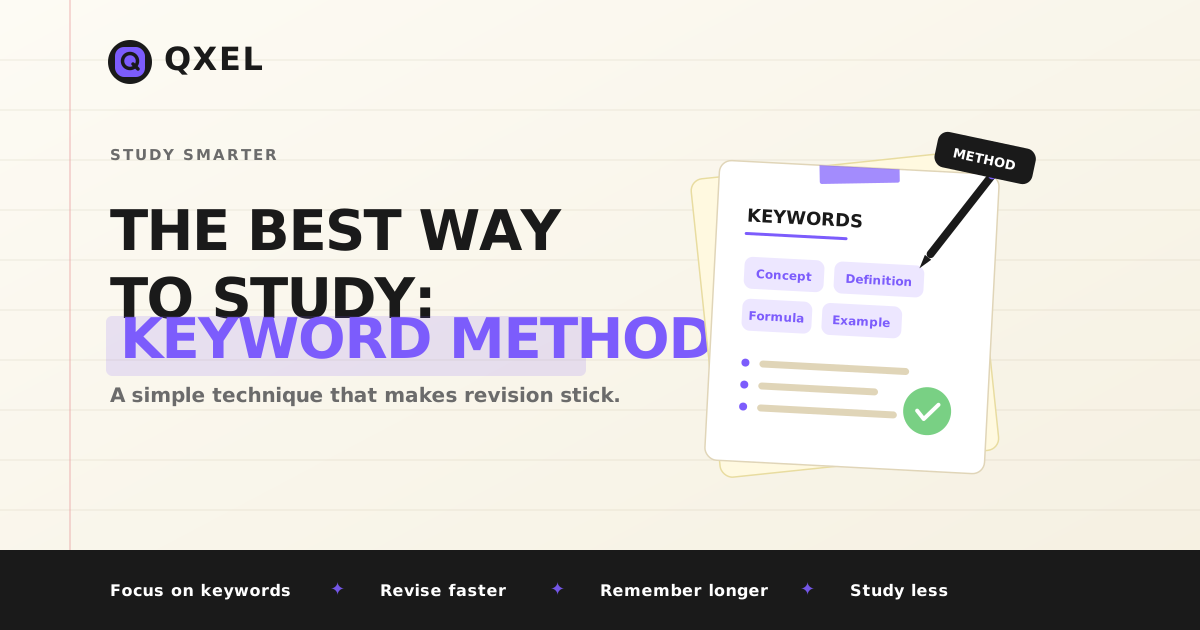
This approach is often called the Keyword Study Method.
Why Memorizing Everything Doesn't Work
Many textbooks contain hundreds of pages.
Trying to remember every sentence exactly as written is difficult and time-consuming.
By the time you've finished memorizing one chapter, you may have forgotten another.
Instead of remembering every word, it's often more effective to identify the important concepts that help you recall the rest of the information.
What Is the Keyword Study Method?
Almost every paragraph contains one or two words that capture its main idea.
Those words become your keywords.
When you remember the keyword, your brain can often reconstruct the surrounding explanation.
Instead of memorizing a full paragraph, you memorize a small trigger that helps you remember the rest.
Example 1
Imagine you're studying the water cycle.
Instead of remembering an entire paragraph, you focus on four keywords:
- Evaporation
- Condensation
- Precipitation
- Collection
Just seeing those four words is enough for many students to explain the complete process in their own words.
Example 2
Suppose you're learning the process of photosynthesis.
Instead of memorizing every sentence, you could remember:
- Sunlight
- Water
- Carbon Dioxide
- Chlorophyll
- Glucose
- Oxygen
These keywords act as a framework, making it much easier to recall the complete explanation during an exam.
Why Keywords Work
Our brains are generally better at remembering associations than long blocks of text.
A single keyword can trigger an entire concept you've already understood.
That's why it's important to understand the topic first, then use keywords to reinforce your memory.
Keywords are memory aids—not a replacement for learning.
Should You Create Keywords Yourself?
You can.
But imagine trying to create keywords for every paragraph in a 400-page textbook.
That could take days.
For many students, exams would arrive before they finished preparing their notes.
That's Why Keyword PDFs Are Popular
Many students create keyword-based notes after completing a subject.
These materials summarize large chapters into concise keywords and short explanations.
Instead of spending hours building your own, you can learn from notes that others have already prepared.
This saves time while giving you a structured way to revise.
Where Can You Find Keyword Study Materials?
Many students now share and sell keyword-based notes online.
On marketplaces like Qxel, creators can publish:
- Keyword PDFs
- Revision Notes
- Exam Summaries
- Quick Revision Guides
- Important Questions
- Subject-wise Notes
These resources can be especially useful during revision when you want to quickly revisit the most important concepts.
Does This Method Guarantee High Marks?
No single study method guarantees top scores.
Success in exams also depends on factors such as understanding the subject, regular revision, practice, and the exam format.
The Keyword Study Method is simply one strategy that many students find useful for organizing information and improving recall.
Different students learn differently, so it's worth experimenting to see whether this approach fits your learning style.
Final Thoughts
Studying doesn't always have to mean memorizing hundreds of pages word for word.
Sometimes, remembering the right keywords is enough to unlock the ideas behind an entire chapter.
By focusing on the concepts that matter most, revision becomes faster, less overwhelming, and easier to manage.
Whether you create your own keyword notes or use materials prepared by other students, the goal remains the same:
Study smarter, understand better, and make revision simpler.