sell study materials
Published on April 16, 2026 · by Sameem, CEO
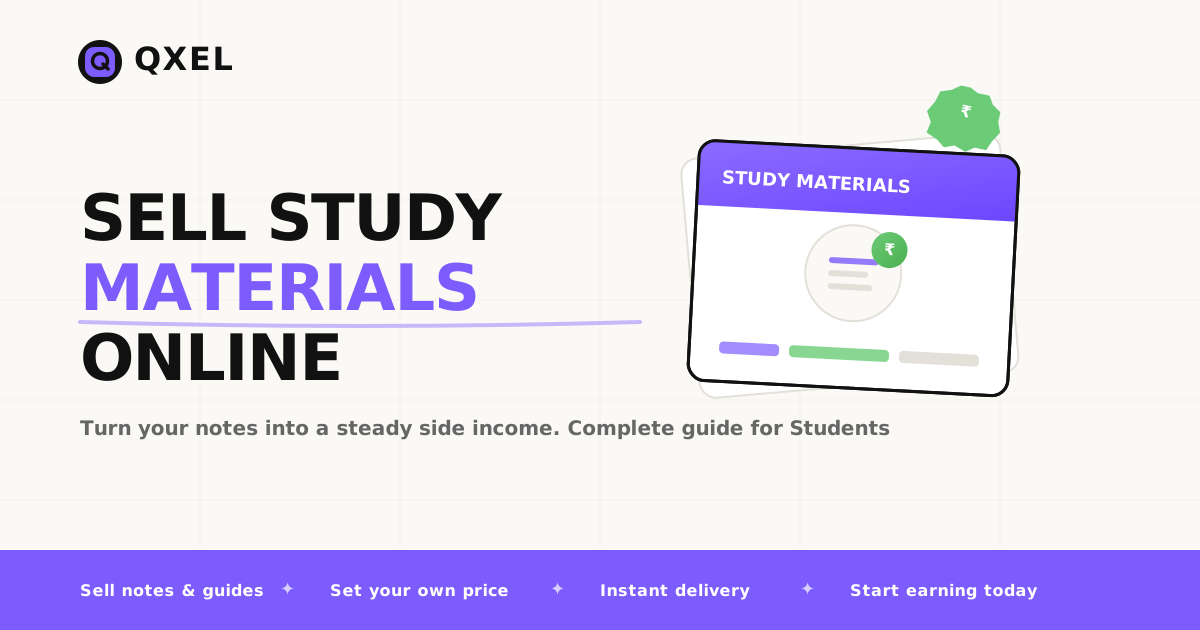
Sell Study Materials Online in India: The ₹5000/Month Opportunity You Are Ignoring
There is a massive shortage of good study materials in India.
Every semester, millions of college students stare at a 500-page textbook three days before the exam and panic. They don't need the whole book. They need quick notes. They need keywords. They need last-day revision material.
And here is the secret: Most professors don't provide it. Most educators don't create it.
That gap is your opportunity.
The Reality of Indian Universities
Let's be honest about how studying works in India:
- Professors rush through syllabi. By the time exams approach, only 60-70% of the syllabus is usually covered in class.
- Textbooks are overwhelming. A single subject might have 400+ pages. A student has 5 subjects and 3 days to prepare.
- Coaching is expensive. Not everyone can afford ₹10,000/month for tuition.
- University notes don't exist. Most colleges provide zero structured study materials. Students rely on "senior notes" passed down via WhatsApp PDFs.
What do students actually want?
They want a 20-30 page document that covers:
- Important topics (based on past exam patterns)
- Keywords and definitions (easy to memorize)
- Short answer questions (2-5 marks)
- Long answer outlines (8-10 marks)
- Diagrams or examples where needed
That's it. Not a textbook. Not a full course. Just exam-focused, easy-to-digest study materials.
Why Study Materials Are a Perfect Digital Product
Unlike video courses or live tutoring, study materials have unique advantages:
| Aspect | Why It Works |
|---|---|
| One-time effort | Create once, sell hundreds of times |
| No face required | You don't need to be on camera or record videos |
| Instant delivery | Automated via platforms like Qxel |
| Low price point | ₹50-₹200 per subject → students buy without thinking |
| High urgency | "Exam in 3 days" drives immediate purchases |
You are not selling knowledge. You are selling time.
A student who buys your notes saves 20 hours of making their own. That is worth ₹150 to them. Easily.
The Math: How Much Can You Actually Earn?
Let's do realistic math for a single target:
Target: One course (e.g., B.Com Semester 3) at one university (e.g., University of Mumbai)
Work Required:
- 5 subjects per semester
- 2-3 hours per subject to create quality notes
- Total effort: 10-15 hours per semester
Pricing (per subject):
- Notes: ₹100
- Question bank (last 5 years solved): ₹80
- Combo (notes + question bank): ₹150
Potential Earnings (per semester):
| Scenario | Students Reached | Revenue (Avg ₹120/subject) |
|---|---|---|
| Small reach (your class + friends) | 50 students | ₹6,000 |
| Medium reach (your college + WhatsApp) | 150 students | ₹18,000 |
| Good reach (multiple colleges, same syllabus) | 500 students | ₹60,000 |
Per month (over 4-month semester): That's ₹1,500 to ₹15,000 per month.
For 10-15 hours of work per semester.
That is an hourly rate of ₹400 to ₹4,000.
Compare that to tuition or freelancing. This wins.
Which Subjects Have the Highest Demand?
Not all subjects are equal. Focus on these categories:
1. High-Failure Subjects
- Engineering: Mathematics, Mechanics, Thermodynamics
- CA/CS: Accounts, Costing, Law
- B.Sc: Physics, Chemistry, Statistics
Students will pay anything to pass these.
2. Theory-Heavy Subjects
- Management: Organizational Behaviour, HR, Marketing
- Arts: History, Political Science, Sociology
- Commerce: Economics, Business Law
Students need memorization-friendly notes.
3. Practical/Formula Subjects
- Accounting: Journal entries, Final accounts
- Finance: Ratio analysis, Valuation
- Programming: C, Java, Python (code snippets + explanations)
Students want solved problems they can practice.
4. Professional Exam Subjects
- GATE, CAT, CLAT, UPSC optional papers
- University-specific entrance exams
Higher price point (₹300-₹500) possible here.
How to Create Study Materials That Students Actually Buy
Most creators fail because they just dump textbook content into a PDF.
Don't do that.
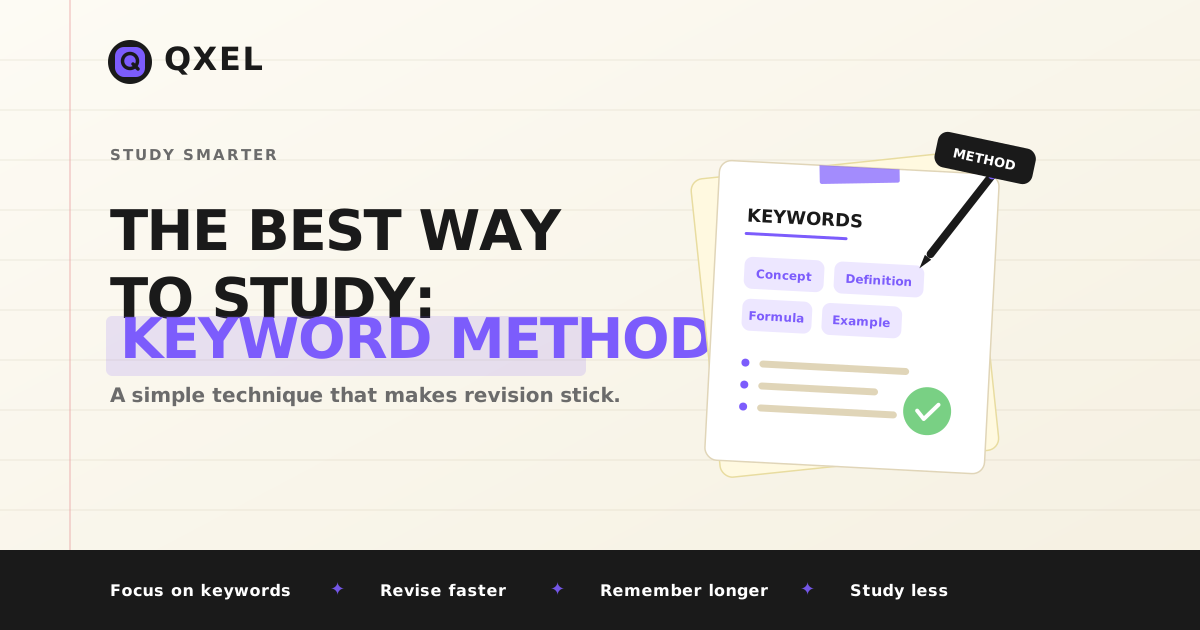
Follow the Keyword Study Method (what students actually use to pass):
Step 1: Collect Previous Year Papers
Get 3-5 years of exam papers for that subject.
- Mark which topics repeat every year
- Note the marks distribution (2 marks, 5 marks, 10 marks)
Step 2: Create a "Keyword First" Structure
For every topic, present it as:
- Keyword (one word to trigger memory)
- One-line definition
- 3 bullet points (exam-ready)
- Example (if applicable)
Example (Economics - Law of Demand):
Keyword: Price Down, Demand Up
Definition: Other things constant, quantity demanded increases when price decreases.
Points:
- Inverse relationship between price and demand
- Works for normal goods only
- Assumes no change in income, tastes, or prices of other goods
Example: When mango price drops from ₹100 to ₹60, people buy more mangoes.
This is how students actually study one night before an exam. Give them exactly this.
Step 3: Create Three Versions
| Version | Length | Price | Purpose |
|---|---|---|---|
| One-day-before notes | 10-15 pages | ₹50 | Last minute panic |
| Complete unit notes | 30-40 pages | ₹120 | Week-before preparation |
| Question bank + solutions | 50+ pages | ₹150 | Practice focused |
Step 4: Format for Mobile Reading
- Use large enough font (12pt minimum)
- Add headings and subheadings
- Use bullet points (not paragraphs)
- Add a "Keywords Summary" table at the end
- Export as PDF (universal, works on every phone)
Do NOT:
- Use fancy fonts
- Add heavy images (increases file size)
- Write long paragraphs
- Forget page numbers
Where to Sell Study Materials in India
Option 1: Qxel (Recommended for Beginners)
Why Qxel works for study materials:
- Zero monthly subscription → You pay nothing until you sell
- UPI payments → Students pay via GPay/PhonePe instantly
- 6% fee → Keep ₹141 on a ₹150 sale (vs ₹94 on Gumroad)
- Instant PDF delivery → Automated after payment
- Indian Rupee pricing → ₹99, ₹149, ₹199 looks normal to students
Pricing strategy on Qxel:
- Single subject notes: ₹99
- Combo (3 subjects): ₹249
- Full semester (5 subjects): ₹399
Option 2: WhatsApp + UPI Direct
- Sell directly to your college batches
- Share sample pages for trust
- Collect payment via GPay/PhonePe
- Send PDF manually or via Telegram channel
Limitation: No automation, no discovery (students can't find you organically).
Option 3: Telegram Channel (Subscription Model)
- Create a private Telegram channel
- Charge ₹50/month for access to all materials
- Post new notes as you create them
Works well after you have 200+ interested students.
Realistic First Month Strategy
Don't try to cover every university. Start small.
Week 1: Pick your target
- Your own university
- Your own course
- The semester you just passed (freshest memory)
Week 2: Create notes for 2 subjects
- Use the Keyword Study Method
- Get feedback from 2-3 classmates
- Revise based on feedback
Week 3: Setup your shop
- Sign up on Qxel (free)
- Upload PDFs
- Set prices (₹99 per subject)
- Create a simple cover image (Canva is free)
Week 4: Share with first 50 students
- Your class WhatsApp group
- College Discord/Telegram
- Instagram story (your friends share it)
Expected result in Month 1:
- 20-30 sales
- ₹2,000 - ₹3,000 revenue
- ~₹200/hour for your effort
Month 2 and beyond:
- Add remaining 3 subjects
- Add previous year question banks
- Expand to similar courses in other colleges
- Target ₹10,000+/month
Legal & Quality Tips
Is this legal?
- Yes, creating your own study notes is legal
- Do not copy entire textbooks verbatim
- Do not use copyrighted images/diagrams without permission
- Your notes should be original writing based on your understanding
How to ensure quality?
- Get one topper from your class to review
- Update notes every semester based on new exam patterns
- Keep Qxel Watermark in products so the students will refer more students
- Respond to buyer questions (they help you improve)
How to handle refunds?
- Digital products are usually non-refundable
- Include detailed view in description so buyers know what they get
- This eliminates "I didn't like it" refund requests
The Opportunity Summary
| Question | Answer |
|---|---|
| Who can do this? | Any college student or recent graduate |
| Time investment | 10-15 hours per semester (one-time per subject) |
| Money investment | ₹0 (free to start on Qxel) |
| Expected earnings | ₹1,500 - ₹15,000 per month |
| Difficulty | Low (you already know the syllabus) |
| Scalability | High (one subject → many colleges with same syllabus) |
Final Word: Start Before Next Semester
Here is what most students will do:
- Read this post
- Think "that's a good idea"
- Close the tab
- Do nothing
- Complain about having no money next semester
Don't be most students.
Right now, while the syllabus is still fresh in your mind, open a Google Doc. Pick one subject. Write the keywords. Make the notes.
Upload it to Qxel. Share the link in your class group.
See what happens.
Worst case: You lose 2 hours and learn something about selling.
Best case: You build a ₹10,000/month income stream that renews every semester.
The exam season comes every 4 months. Be ready before it arrives.
Ready to start?
No subscription. 6% fee. UPI payments. Start selling study materials today.